


‘Plant topia’ students prepare for Byron plant sale
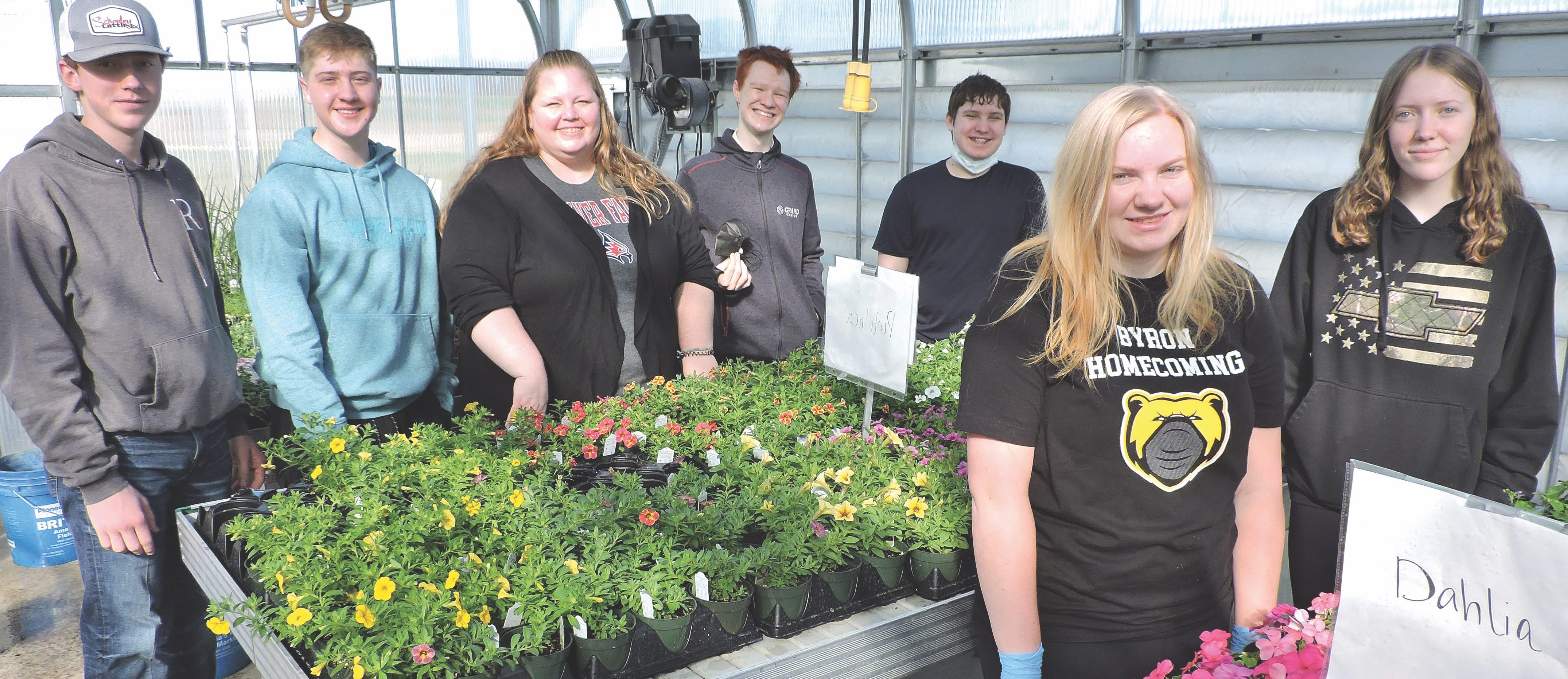
Byron High School’s agriculture program has been growing flowers and vegetables in the school greenhouse and is now in its eighth year of hosting the annual plant sale. Vo-ag instructor, Alison Newman, who is in her 16th year of teaching at Byron, said they will have 2,300 flowers in individual containers, 100 hanging baskets, and 800 4-packs of vegetables with different varieties for sale.
The plant sale will be held on Saturday, May 8, from 9 a.m. – 1 p.m., unless they sell out earlier. The sale will be near the school greenhouse location. COVID-19 restrictions have changed the sale schedule again this year, she said.
Alison calls her class “plant topia” as it was easier to relate that name to her students than using the traditional term, horticulture. This class is held in two sessions that interested students can enroll in: January – March, and March – end of the school term.
The class meets Monday through Thursday from 8 to 9:20 a.m. There were 23 students in the first term and eight in this spring session.
Alison said she needs to order the seeds and plants in the fall and they are delivered the first part of March. The flowers come in two-inch plugs and are then transplanted into pots. Students in the first session get the greenhouse ready and will put the soil into the containers and get them watered and labeled so they are ready to plant the seeds.
The second session students do the vegetable planting, take care of the watering, insect control, and care of the growing plants. The students pick out the various flowers, with the help of their advisor, which will be used in the hanging baskets. Alison tries to select flowers with bright colors and ones that people will want to have at their homes.
The students learn plant varieties, pricing, and marketing techniques using various social media sites, posters, flyers, newspapers, and word of mouth to let the community know about the upcoming plant sale.
Alison said their prices are competitive with area greenhouses. Since it is a school project, the goal is to recover all the input costs to pay back the school and maybe even make a small profit. They reuse the trays but their expense is the seed, soil, and the new containers. Alison said she tries to run the operation similar to a commercial greenhouse.
The students are involved with the operation and recently Hannah Gronseth and Gracie Jestus were gathering flowers to design hanging baskets. Nick Russman and Garrett Johnson were putting on a small amount of insecticide to control any aphids while Caleb Devilibiss and Luke Bjellum were busy watering the containers. Two of her students attend virtually so they are busy in the marketing and making signs telling the best area location to grow flowers according to how much light they will need.
In the summer the greenhouse is used to grow tomatoes for the food truck and they work with the business and Family Consumer Science instructors for this program. Alison mentioned one of her students worked part-time at a grocery store and then moved from the cashier position to the garden location so was able to use some of the skills from her high school class.
The majority of her students are nonfarm residents but likely have a parent, a grandparent, or a close relative that has lived on a farm. Everyone is a consumer of agriculture products so students learn about the importance of plants and animals for our food source.
Most students will get involved with some type of gardening during their lives so it gives them a chance to learn how to take care of plants when the time comes. Many of her students will not likely be involved directly in production agriculture in the future but others will find opportunities in agriculture and food safety careers.
She also said there are about 30 students enrolled in the Byron FFA chapter of which she is the advisor. Once again this year, the annual state FFA convention held last week was not able to be held at the University of Minnesota St. Paul Campus but was held virtually.