


Local auctioneer began life on an Iowa farm
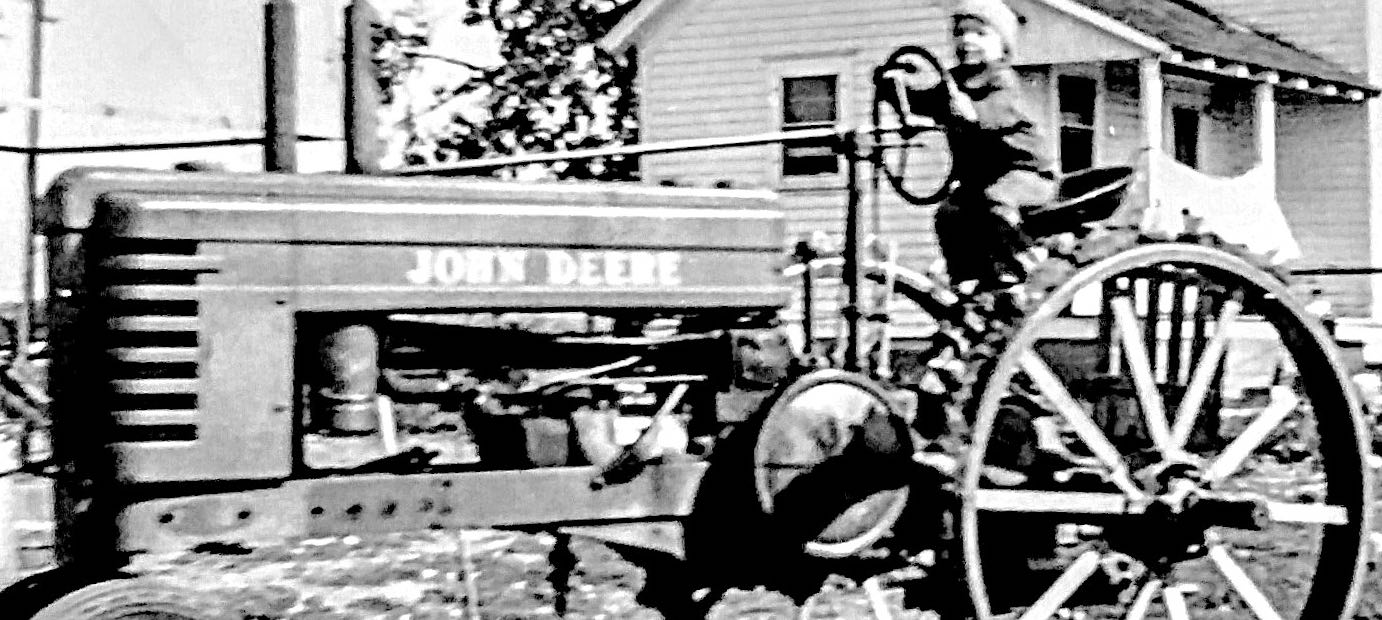
Charlie Sinnwell grew up on a farm between Nashua and Ionia, Iowa, near the location of the Little Brown Church. He was the oldest of 10 children. Charlie said since he was the oldest he helped his parents get their parental training which helped the rest of his brothers and sisters.
Life on the Farm
His parents farmed with horses and a John Deere B, plus they raised hogs, cattle, chickens, and crops. They milked cows by hand, shocked and threshed oats and stacked hay into the barn loft. The long grass was cut with a hay knife into smaller bunches and thrown down a chute to feed the cows.
One time when cutting the hay, he said he fell into a large hole in the hay as the hay had caught fire and burned itself out because of lack of oxygen which was a good thing. When they started putting hay bales in the barn they needed to reinforce the floors.
They used a grain binder to cut the oats that they would shock and then bring it to their yard to be threshed. The oats went into the wagon and the straw was blown into a large stack. Sometimes a shelter was built of wire and a few posts and then the straw was blown on top of it with a small opening so the hogs could get inside to use it as a warm shelter on the cold winter nights, Charlie said.
The corn was also cut with a binder, shocked and then hauled to the silo where a cutter blew it into the silo for cattle feed. One time when Charlie was up in the silo leveling it off a neighbor kid decided to have some fun with him and caught a chicken. When he threw it into the cutter the blood and guts came up the pipe and Charlie thought someone must have gotten hurt, he said.
Charlie said the worst job on the farm was cleaning the chicken house in the spring as it has a lot of ammonia smell so he remembers wearing a red handkerchief over his face and nose to help. The first time Charlie took the horse drawn manure spreader out to the field, the horses were pulling hard through two feet of snow. The spreader had a beater in the back that spread out the manure in a fan direction when he put it in gear, he said.
There was a strong wind blowing toward Charlie. His dad never told him to watch for the wind directions as he thought experience was the best teacher! It only happened once!
Since they did not have running water, they used the windmill to pump the water tank full. They would put an iron box in the tank for firewood and burn oil or wood to keep the water from freezing so the cattle could drink from it. Of course there was no running water in the farmhouse either so they had the “outhouse” for relief.
The telephone was mounted on a wall and they had to crank it for a specific number of times to get the four or five neighbors on the line. If you picked up the phone, Charlie said, you could listen to the conversation going on. If you cranked it enough times you could get the operator and they could then call other people.
Later they got a “dial” telephone where you could call people but still had to dial the operator for long distance calls. Nashua Telephone Company was the first company in Iowa to have the “dial” system, he said.
When electricity finally came to their community after WWII, they got a milking machine and his dad bought Holsteins as before they had milking shorthorns who didn’t give as much milk. When the cows broke through the fence in the middle of the night, his parents got the kids out of bed to get the cows back in the yard again.
The farm had a daytime pasture so sometimes Charlie had to walk a half-mile to get the cows who would walk through the water holes splashing out the mud so they continued to become deeper. His dad would fill the holes with corncobs to prevent this, Charlie said.
The beginning of Charlie's fast pitch lessons started when he would break the cobs into three-inch sections and throw them underhanded. He learned to spin them, make them curve, go up or down movements and was able to hit a fence post so it was cheaper than hiring a pitching coach.
Off to Country School
As the family grew in size, his mother hired a neighbor lady girl to help with some of the housework. He said he started school at the country school about 1-½ miles away and walked there some of the time. One day walking home with his sister, they spotted a cyclone in the sky and they thought it was heading toward their home. It did miss their house by about a quarter mile but did some damage at a neighbors place. It also headed to Ionia where it took down the house next to where his mother was getting her hair done and one person was killed.
When Charlie was in second grade they went to St. Boniface Catholic School in Ionia along with his sister. They had Mass every morning and a religion class and the sisters of St Francis were their teachers.
There were five kids in his class and three of them were his second cousins, so Charlie said he was always in the top five of his class! They had no extracurricular sports until he was in eighth grade when he played on the B Squad basketball team. They would travel to other towns as their school only had the church basement to play in, so they learned to dribble and run some plays but had no shooting because of the low ceilings.
When Charlie was in eighth grade he contracted rheumatic fever, probably from drinking non-pasteurized milk, as did some other classmates, he said. This caused a heart murmur so he was confined to bed part-time and stayed in the house. His dad bought a new John Deere 50 but since he couldn’t go outside his sister got to drive it so that made him a little jealous.
In the summer of the eighth grade he turned 14 and in Iowa it made him eligible to get a farmers driving license that meant he could drive to town for related items and to school. The first car he drove was a 1950 Chevy but they also had a 1950 Ford ¾ ton pickup that they drove to school at times.
One time he took a hog to the locker because his uncle owned the creamery and locker. The hog jumped out while he was driving and it slid down the road. While the hog was still dazed, Charlie opened the truck tailgate and lifted it back into the pickup but it did have a damaged ham.
During his high school years, five of the boys would put on boxing gloves during the noon hour in the winter and box each other on the stage in the church basement.
Charlie did play some softball with the church team with his dad starting in eighth grade. When he was a sophomore he tried out for the Nashua men’s baseball team but didn’t enjoy it much so he went back to playing softball the next year at third base. The following year he started his pitching career.
Starting a Career
Upon graduation he worked construction and helped build the Plainfield, Iowa high school addition. He continued to play ball with Ionia and then the Plainfield team offered to pay him $15 per game to pitch so that was the beginning of his pro career!!
He bought a1953 Mercury but every time he crossed a bridge or railroad track the headlights would quit. When the school was built in time for the new school year he went to work for the Oliver Corporation in Charles City in the foundry. He bought a new 1959 Ford two-door for $2,900 and borrowed the money from his parents. In November the whole country went on a steel strike and he got laid off at Oliver.
Charlie contacted the new John Deere dealership in New Hampton, Iowa who also farmed 1,000 acres. He got hired to help get the crops harvested and eventually helped set up new machinery in the shop plus painting old tractors to look new once again. While harvesting the crops with a JD 55 combine, which did not have a cab, he ended up freezing his feet and each winter they would swell up and in the spring would break open and drain for a couple of days before they would heal up. This health issue finally quit after 10 years.
In 1960, the dealer sent Charlie to the John Deere mechanical school in East Moline, Ill. to learn how to work on four and six cylinder engines as before this they were only two cylinder engines. He married a neighbor girl in 1961 and came back and worked as a mechanic for two years. They decided to start farming as her parents had moved to Minnesota and they could rent their land and some additional land near his parents plus share machinery. His dad milked cows and Charlie had feeder cattle in addition to the 765 acres they farmed which was a lot in those days. He continued to play softball when it didn’t interfere with farming, he said.
When natural gas was piped into Ionia, the hardware store owner and plumber, who also was the softball manager, asked him to work for him installing the gas to homes in his spare summer time. After the crops were harvested in the fall he went back to the John Deere dealer to work in the shop until spring.
In the fall of 1964 the farm they were on was sold, so he didn’t know what they should do. He went to Geneva, Minn. to look at the livestock sales barn but heard the sales barn in Kasson was for sale so bought he bought it.
Next Week: The Sinnwell’s continue their new life in Kasson.