


Maple syrup time at Cowell’s home
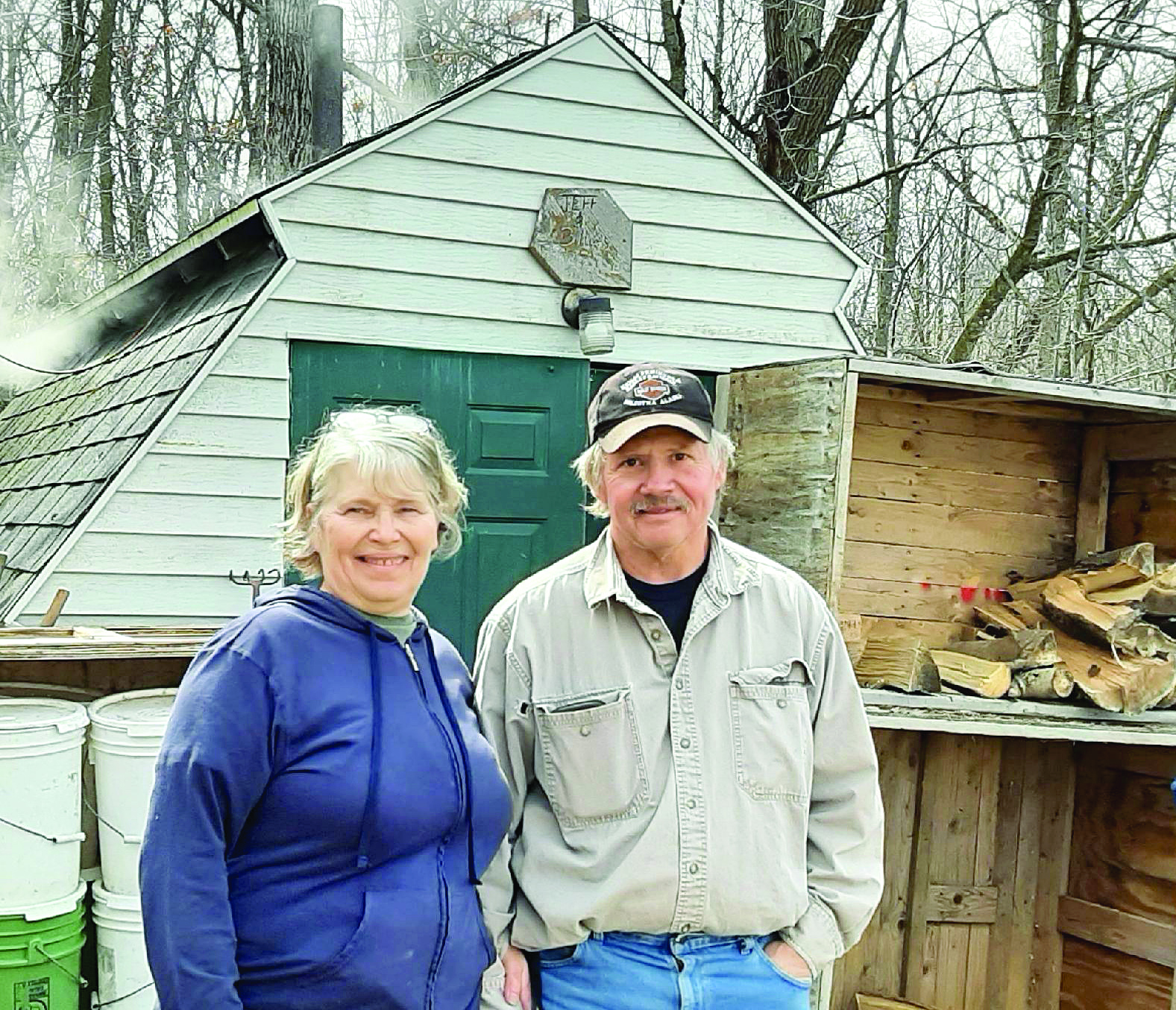
The sap was cooking and the steam rolling out of the vents in the roof of the sugar shack at Jeff and Billie Cowell’s home in rural Claremont, where they produce an average of 40 gallons of maple syrup each year.
In late winter, the Cowells start watching the warming temperatures, knowing that soon the sap will start running. “Sunny days followed by freezing nights, that’s what we look for,” Jeff Cowell explained, “because that’s what makes the sap run. The warm days draw the sap high up into the trees, and when it freezes, that draws the sap back down...It started mid-March this year.”
They collect sap every day, and carry the syrup out of the woods by hand in five gallon pails. Jeff puts a wooden yoke across his shoulders and balances a pail on each side. “On our 300-gallon day, that was 30 trips from the woods through snow or the mud,” Jeff said. They currently have three properties where they tap trees, and have started some sugar maples in their yard, but it will be several years before they’re big enough to tap. At some of the locations where they collect sap, they can use a four-wheeler with a trailer to haul the buckets to the sugar shack.
“We collect sap every day and filter it in case we have a chunk of bark or a leaf or something in it, and then take the clean sap and run it through the cooker,” Billie said. “That’s the only ingredient, sap. The sap looks like water, and just barely has any sweetness at all. It’s probably a thirty to one ratio that you have to boil down.”
Jeff built the building they use for cooking the sap, affectionately called the sugar shack. He put vents on both sides of the roof so the steam can escape easily. Inside the sugar shack is the syrup-making equipment Jeff designed and built.
The cooking pan, situated over a wood fire, is 30 by 60 inches and holds 40 gallons of liquid. An attached preheating pan is 12 by 30 inches and holds 18 gallons. Billie explained that it works better to preheat the sap and gradually add it to the main pan as the sap cooks down, rather than pouring cold sap into the boiling syrup and then having to wait for it to come back to boiling.
Once they get started, they cook the sap around the clock, checking it every two and a half hours. With Jeff working ten-hour days, and Billie working part time at Triton, it’s a hectic time without much sleep. They try to process about 250 gallons of sap per batch, which gives them about eight gallons of maple syrup. They start the process with 40 gallons and continue adding sap and cooking until they have eight gallons left in the cooking pan.
“When we get to the end we use a hydrometer to test the specific gravity. That tells us the exact sugar content in it,” Billie explained. “If you cook it too far, it will crystalize, and if you don’t cook it down far enough, you’ll have runny syrup,” Billie said.
Finishing a batch is a process that takes at least two people. When the syrup is finished cooking, they slide the pan off the fire using a metal arm custom-designed and made by Jeff. They then use a pulley attached to the rafters to carefully tip the syrup into ten-gallon buckets and store it until they transfer it into pint jars that they market by word of mouth.
“We’ve been doing this about 25 years,” Billie said. Their neighbors, Ed Pitzenberger and Mark Lenz, were doing it when they first moved to the rural neighborhood east of Claremont. “Mark had a nice little shack and a smaller pan,” Billie recalled. “They did it on a smaller scale than we’re doing it. The first year we did it on a cement slab with plywood slabs set up to keep us out of the wind.”
“The first time we took syrup out of the pan, it was so hot, it melted some of our garage siding,” Jeff said. “That’s when I built the building for cooking the sap.” Mark has moved out of the neighborhood, but Ed is still their workhorse, according to Jeff. Ed and a couple other neighbors still come over and help regularly.
Billie is the retired food service director for Triton schools in Dodge Center, and the Cowells have invited Triton kindergarteners to come out and visit their sugar shack each spring for the last several years. They have a maple log set up with a tap inserted and a plastic collection bag hanging from it, so they can demonstrate how they get the sap from the trees. The visit always includes giving everyone a chance to taste the maple syrup. Billie has given syrup making demonstrations at Kasson Mantorville and other schools as well. She is always happy to educate people about local food and where it comes from, especially the maple syrup.
As with all types of food production, the harvest varies from year to year. Their biggest day collecting was 300 gallons, but on average, they collect from 180 to 250 gallons a day. “The sap stops running when the leaves start budding,” Jeff said. This year, that was around April 1. They average 40 gallons a season. This year, they will have about 24 gallons, and last year they had 60.