


Jim Allen's medical career leads him into neurology
Correction from Part 2: Marjorie O`Brien of Kasson should have been listed as the person who married Jim`s brother, John--not as Jim`s English teacher.
(Editor’s Note: James Allen is a Byron native and graduate of Byron High School. Parts 1 and 2 told of his years growing up on a farm in the years before and during World War II. This continues the story through medical school, practice and retirement.)
Jim was able to cram the Pre-Med experience into three years. He had a very meager background in math, science, and composition compared to many of the Pre-Med students, but Jim achieved a GPA high enough to be accepted into medical school, so his prayers had been answered!
Jim’s second year of medical school was much more interesting, and finally he could see things that he would be able to use as a physician. He would practice physical diagnosis on Elaine at home, listening to her lungs, heart and looking in her eyes. When he listened to her heart, he heard a loud murmur, and it was terrifying to both of them. Further studies were carried out, and it showed it was a congenital functional murmur, and would not appear to have significance for the future.
Elaine finished up her fourth year at the University of Minnesota and she received her BA degree while Jim was in his second year of medical school. She took a job in the family business and was able to finance the rest of his medical school training supplemented by Jim’s summer fellowship earnings. It was a great day when Jim graduated from medical school with their families in attendance, and he was the first medical doctor in his family’s history.
Jim took his internship at St. Mary’s Hospital in Minneapolis, and it was a very good experience working with the nuns. Obstetrics was the toughest rotation because he was on for 36 hours, and then off for 12 hours during those two months. He then worked with a solo practitioner in Golden Valley for a period of time. During this time, he also received his draft notice, but after taking a medical exam he was turned down because he was color blind and had poor eyesight.
He then was at the Northeast Medical Clinic for three years and had some great experiences there. He was a young 25-year-old general practitioner in Northeast Minneap olis in a predominately Polish and eastern European neighborhood of hard working, honest people with large families. He quickly learned it was better to call the diagnosis “walking pneumonia” rather than “bronchitis” when dealing with macho men as it made them feel extra tough to be walking around rather than being in bed.
On one of the more memorable house calls, the father of a family called Jim. He had very broken English, but Jim was able to determine that something significant was going on. Members of the family were running to and from the bathroom because of diarrhea. It was determined that they had bought a chicken and left it on the kitchen counter too long. It was a safe bet that it was salmonella poisoning, so Jim called an ambulance to pick them up and bring them to the hospital to get them properly treated.
During a house call on a very cold and dark winter night he was carrying his large black medical bag filled with various medications. When he was walking up the driveway, a large German Shepherd dog from next door leaped through the air toward his throat. Jim swung his bag and knocked the dog over. The neighbors quickly came outside, jumped on the growling dog and pulled it away.
Jim had drawn the short stick to be on call over Christmas. At 7 a.m. on the first workday following the holidays, a man called and asked if Jim could make a house call. Jim went to the home and found the man had a very high fever and a rigid abdominal wall. The man said he began having abdominal pain on Christmas Eve but didn’t want to bother Jim over the holidays. Jim admitted him to the hospital for peritonitis secondary to a ruptured appendix. With surgery and antibiotics, they were able to restore him to normal health.
They conducted part of their practice with another small hospital in southeast Minneapolis that only had a few doctors on staff. They would take the patient charts back to their office to work on during the slack times. On a windy March day, one of the doctors carried a stack of the charts outside and placed them on the trunk of his car while he and Jim talked. After they said goodnight, they both drove off and the charts were scattered over northeast Minneapolis, aided by a strong wind. They got phone calls all through the night, and the next day with charts being found. From that day on the doctors were not allowed to take the charts out of the hospital.
During an influenza outbreak, Jim had the flu, and both of his office partners were out of town, so he needed to see the patients in the office and be on call. He had a fever more than 103 degrees and aches all over. He saw 96 patients that day in addition to making hospital rounds, and then delivered babies during the night. When he lost his voice in the afternoon, his nurse had to ask the questions of the patients about their complaints and communicate the treatment written by Jim. Jim’s wife carried out that duty at night answering the telephone calls.
Sometimes frustration would lead the doctors to unusual tactics. A doctor saw a man for bronchitis/pneumonia many times who had been advised to quit smoking, but he continued his two or three pack per day habit. The doctor wrote a prescription for a funeral home located a few blocks away. He told the man since you don’t want to listen to me, and you keep smoking, this is where you are headed anyway. The man was so shocked that he quit smoking immediately, and his health improved after that.
After three years in general/family practice Jim became frustrated by having to refer all of the most interesting cases off to specialists. He considered neurology and met with the chairman of the University of Minnesota department. There was one three-year residency slot available and after discussion with his wife, Jim decided to take it.
It was a difficult time because they now had three children, and Jim was working long hours on the residency, covering night calls, moonlighting at a private hospital covering an emergency room and hospital emergencies to make extra money for his family to survive and studying. They had bought a “starter” house in Edina for $28,500, and a 300-acre parcel of land in Polk County for $12/acre and cleared the land for a cabin to be built. As the saying goes, “You can take the boy out of the farm, but not the farm out of the boy.” It was busy, but the family enjoyed lots of family activities.
Jim often worked 60 — 70-hour weeks and his wife, Elaine, did a lot with the care of the children, but she also worked part time in the family business. When her father died, she had total control of the company, and this was also when Jim was going through paralysis from Guillain-Barre Syndrome. They managed to attend their children’s sporting events, music programs at school, time for games, television, and other activities at home and at the cabin. The family also took many trips as travel was a high priority for them. Jim and Elaine traveled to all seven continents, over 30 countries and many states.
After Jim finished his residency in neurology, he had several job offers but decided to try it in a solo practice for a time. He rented a space in the Medical Arts Building, and later accepted an offer from the Minneapolis Clinic of Neurology for outpatient practice in Golden Valley and in-patient practice at St. Mary’s/Fairview Riverside.
When he first practiced neurology, they did not have CT or MRI scans. They had EEG (brain wave tests), EMG (electrical nerve and muscle test), and he could do a spinal tap in addition to our clinical history and examination. He had to rely a great deal more on his knowledge of neuroanatomy and neurophysiology to diagnose different conditions, whereas technology has greatly simplified the process.
Since many people living in rural areas did not want to come to the cities to their clinic, they would travel by plane or car to these locations at times. Several of those flights were made in some scary weather conditions as well as driving on icy snow packed roads.
At the age of 65, Jim retired from active clinical practice, but he continued to teach in the University system as a Clinical Professor of Neurology and carry out independent medical examinations. He had originally thought he would do that for a couple of years, but he has continued doing neurologic consultations on persons who have had neurologic injuries, and he gives the profits to church and charity. He limits consultations to two/week on Mondays so now Jim has a six-day weekend!
All three of Jim’s children live within a few miles of his home in Edina. Three of his grandchildren are finished with college, with two living in Washington DC and one is in oceanography research at the University of Miami. The fourth will be wrapping up college at the University of California and then maybe medicine?
Jim’s siblings, Bill owned and operated a farm near Adams, and now rents it out. He was also a mason and loved building fireplaces and patios of stone and brick. Bill is 96 years old and lives in Rochester. John, a CPA, died at age 93, and was a pilot in WWII. Dick, an attorney, died in his 80’s.
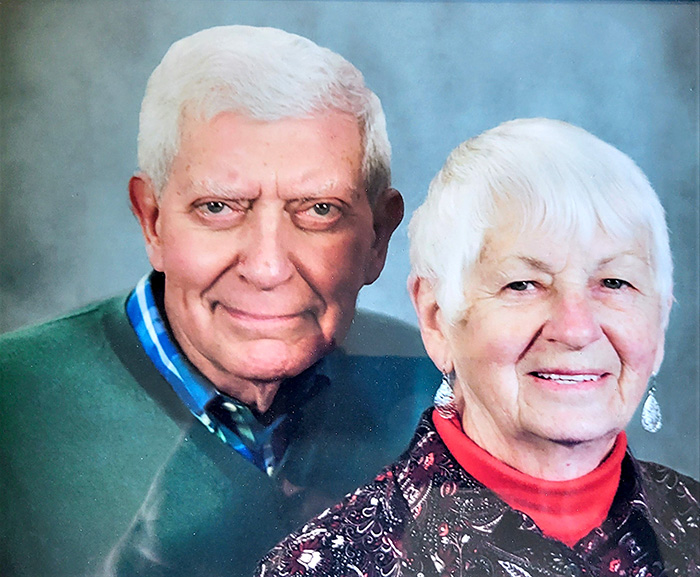
Jim still lives in the three-bedroom rambler “starter home” which was bought in the 1960’s, and now it has two bedrooms and an office. Jim’s wife, Elaine, died from pancreatic cancer in 2020. In 2022, he married Sandy Dahle, who was also a student at Byron. They lived on adjacent farms and rode the same school bus. Sandy owns a townhouse in Kasson, so they split their time between the two homes. They attend South Zumbro Lutheran when they are back at their “southern” home!